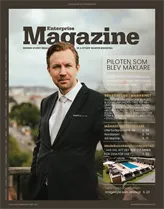
Regissören som fotar världens kändisar
Fotografen och regissören Peter Svenson har en lång meritlista och är ett sant bevis på att om man tror på sig själv och...





When Enterprise Magazine visits IUS Tax & Law in Gothenburg, there is no sense of rigid formality or unnecessary titles.
The atmosphere is warm, relaxed and distinctly entrepreneurial. There is an energy in the room that says more than words: this is a company still in the process of being built, but also a company with clear momentum.
Behind the venture are Rebecka Belge and Robert Aronsson, two lawyers with a shared background in international taxation and several years of experience working together in the industry. What began as a shared professional everyday life has grown into something of their own: a niche business focused on small and medium-sized companies.
“It is the best professional decision I have ever made,” says Rebecka about leaving employment behind to build something of her own.
Rebecka and Robert both have several years of experience in international taxation. Over time, they saw that small and medium-sized companies with international needs often require advisory support that is both highly specialised and close to the business.
That was where they saw their opportunity.
They wanted to create a focused specialist business for companies operating across borders, often without extensive internal resources of their own.
It is not only about tax. It is about understanding what happens when a foreign company wants to establish itself in Sweden, send staff here, hire a key person or build operations without stumbling over regulations, reporting requirements or authority obligations.
IUS primarily works with companies, often international businesses in what the founders describe as the middle-market segment. What the clients in the core business usually have in common is an international connection: an employee who is going to work in Sweden, an executive who will commute between countries, a company that needs to understand its obligations here or an organisation that wants to get things right from the start.
This is also where IUS has found its strength. The firm enters the process early, structures it, quality-assures it and guides the client all the way, from strategic questions and contract review to registrations, reporting and ongoing advisory support.
“We are involved from beginning to end,” says Rebecka.
In practice, this means that IUS often functions as a complementary specialist resource for internal HR or finance departments. IUS adds specialist depth in areas where internal teams often need external support.
International taxation is an area where mistakes rarely remain mere administrative irritations. If a company gets things wrong, the consequences can involve sanctions, retroactive adjustments, employer-related issues, tax penalties or problems linked to work permits and social security.
Often, the issue is not unwillingness, but lack of knowledge.
Many foreign companies are simply unfamiliar with how Swedish rules work. They do not know which obligations arise in connection with establishing a presence in Sweden, how an employment structure should be set up or when a Swedish presence risks being classified as a permanent establishment. That is why relief is often the first reaction when IUS steps in.
That says a great deal about the company’s position: IUS does not merely sell advisory services. It sells clarity in an area where uncertainty can quickly become costly.
IUS combines a focused organisation with a clear ambition: quality must never be compromised.
Both Rebecka and Robert emphasise that their way of working is based on quality assurance at several levels. Reasoning, advice and substantive assessments are continuously discussed internally before they reach the client. It is a way of maintaining a high professional standard, but also of creating security, both for the firm and for those who engage it.
At the same time, they see their size as an advantage.
In a focused organisation, the work becomes more personal, internal lead times are shorter and the client relationship is closer. The person who takes the meeting is often also the person who actually does the work.
This is also reflected in how IUS wants to be perceived: accessible, easy to work with and highly service-oriented. They want to meet the client where the client is, both professionally and personally.
The journey has already taken IUS further than many might have expected in the company’s early years. What began primarily with Swedish-Norwegian assignments has gradually grown into a broader international client flow, with links to several European markets as well as the US, Canada and China.
On its website, IUS describes how it collaborates with global partners and provides support to both Swedish and foreign legal entities in international matters.
In the interview, it becomes clear that this international network is an important part of the company’s future. In these types of assignments, understanding Swedish rules is not enough. It is also necessary to work effectively with advisers in other countries, coordinate processes and create an overall solution for the client.
That is where IUS wants to continue building its position: as the Swedish specialist with international reach.

Although the core area is international taxation, the assignments have become broader over time. IUS also works with adjacent business-law matters, such as employment law, shareholder agreements, policies and other advisory needs that naturally arise when working closely with companies in transition.
This is also where Rebecka’s and Robert’s entrepreneurial understanding becomes an asset. They do not look at the legal question in isolation, but also at the business behind the decision. What will it cost? What risk does it involve? What is reasonable? What does the client actually need right now?
That kind of understanding is difficult to learn from books. It comes from experience, from proximity to entrepreneurship and from having been part of building a business oneself.
IUS currently consists of three people, and the plan ahead is clear: in 2027, the firm wants to grow to four people, and in 2028 take the next step. Growth will be organic, with the right people and at the right pace.
This is not an aggressive expansion plan for the sake of expansion. Rather, it is a carefully considered strategy where balance is crucial: between today’s delivery and tomorrow’s vision, between quality and capacity, between opportunities and responsibility.
That is also where one of the company’s greatest challenges lies. As a focused firm, every new assignment must be weighed against time, resources and long-term sustainability. Saying yes is not always obvious, even when the expertise is there.
But perhaps that very consideration becomes a strength. At a time when many are chasing volume, IUS chooses to build with precision.
As the conversation draws to a close, Rebecka and Robert repeatedly return to something that rarely appears in proposals or service descriptions, but often determines how far a company can go: relationships.
The relationship with clients. The relationship with international partners. The relationship internally.
They talk about the importance of enjoying work, about building a team where energy and personality actually matter, and about people needing to work well together, especially in a small organisation. It is clear that IUS is not only building a firm. They are building a way of working.
Global business requires specialists who understand both the rules and the human factor. That is precisely the role IUS Tax & Law is taking on, making its growth journey particularly interesting to follow.

Fotografen och regissören Peter Svenson har en lång meritlista och är ett sant bevis på att om man tror på sig själv och...

Sveriges tuffaste matjury är epitetet på juryn i Sveriges Mästerkock. Markus Aujalay är domaren som ger mästerkockarna mardrömmar.

Denis Manasiev Vukotic driver Teknikmagasinet mot nya framgångar!